10%
Formal training
What's learned in a course or a structured module. It's the foundation — but it's the smallest share of real learning.
Definition · Comparison
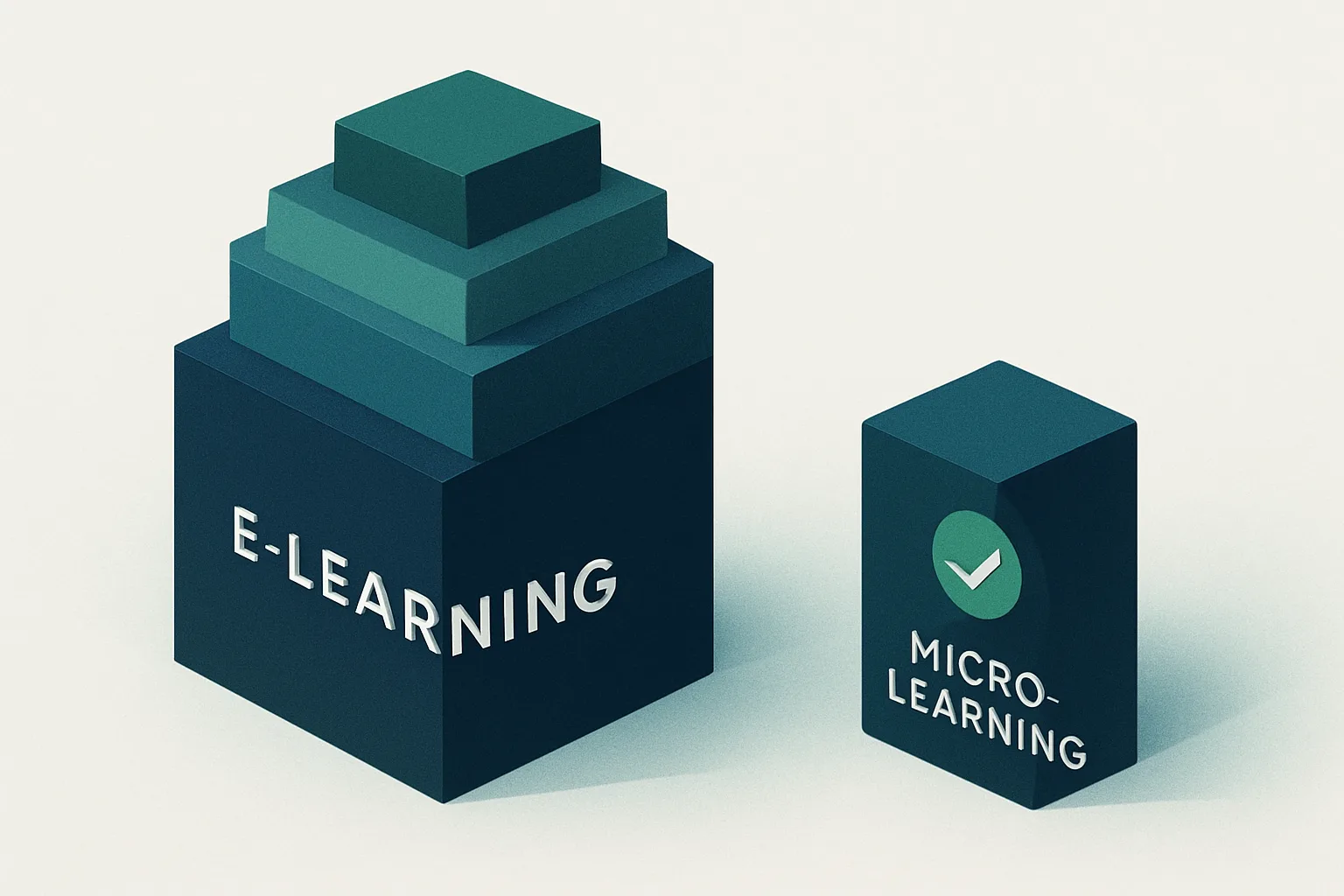
Micro-learning is a form of e-learning: very short content, focused on a single objective, designed for use at the workstation. Classic e-learning, on the other hand, refers to all online training — often longer and broader.
Definition
E-learning refers to any training delivered online, generally structured into modules of 30 minutes to several hours, covering a topic comprehensively.
Micro-learning is an approach to e-learning built on very short sequences — often under 10 to 15 minutes — each centered on a single, directly actionable learning objective. Micro-learning is therefore not the opposite of e-learning: it's a variant of it, designed for memorization and immediate use at the workstation.
In short: all micro-learning is e-learning, but not all e-learning is micro-learning. The real question isn't "which is better?" but "which one for which objective?"
Comparison
The two approaches complement each other. Here's how they differ on the criteria that matter.
| Criterion | Micro-learning | Classic e-learning |
|---|---|---|
| Length of a sequence | A few minutes (often < 10–15 min) | 30 minutes to several hours |
| Objective | A single one, immediately actionable | Comprehensive coverage of a topic |
| Completion | High — the effort required is low | More fragile — drop-offs on long formats |
| Retention | Reinforced by spaced repetition | Risk of forgetting after a single session |
| Ideal use | Critical gesture, reminder, update, at the workstation | Full onboarding, long certification |
| Updating | Fast — you edit one building block | Heavy — you redo the whole module |
Reference framework
This model explains why formal training alone isn't enough — and where micro-learning comes into its own.
10%
What's learned in a course or a structured module. It's the foundation — but it's the smallest share of real learning.
20%
What's learned from others: colleagues, mentors, exchanges. Know-how is passed on through observation and dialogue.
70%
What gets embedded through experience, at the workstation. That's where micro-learning acts: available at the right moment, on the right gesture.
Why it works
One objective at a time: the brain encodes better when it isn't overloaded. The short format limits the forgetting caused by overload.
You pull up a sequence just before or during the gesture. Learning meets on-the-job practice — the 70% of the model.
The visual system processes an image in 13 ms: short, visual content captures attention and aids memorization.
Frequently asked questions
Training
200+ short modules, understandable on the first read, ready to deploy.