
80%
informal knowledge
Most critical know-how is neither written down nor transmissible: it lives in people's heads.
Decision-maker guide · Executive leadership
You've already put everything in place — processes, a quality system, tools, KPIs. And yet your performance still depends on people. When 80% of critical know-how stays informal, every departure, every absence, every handover weakens the whole organization.
2.7 years
median tenure with the same employer for 25–34-year-olds (versus 9.6 years for 55–64-year-olds): know-how changes hands faster and faster.
When the expert who "knows how" leaves, it isn't just a position that empties out: it's a part of the company's performance that disappears. And because that knowledge was never formalized, it takes months — sometimes years — to rebuild, at the price of errors and poor quality.
The real problem
80% of critical know-how stays in the heads of a few people. Completed ≠ mastered.
Key-person risk isn't just an HR risk: it's a risk to operational continuity. Fewer than 30% of processes are actually run consistently, and up to 50% variability separates two operators on the same gesture. As long as knowledge stays informal, your performance hangs on the presence — and the memory — of a few individuals.
80%
Most critical know-how is neither written down nor transmissible: it lives in people's heads.
< 30%
Without captured know-how, everyone executes "their own way" — performance becomes a lottery.
up to 50%
The gap between operators on a critical gesture measures your dependency on key people.
The know-how chain
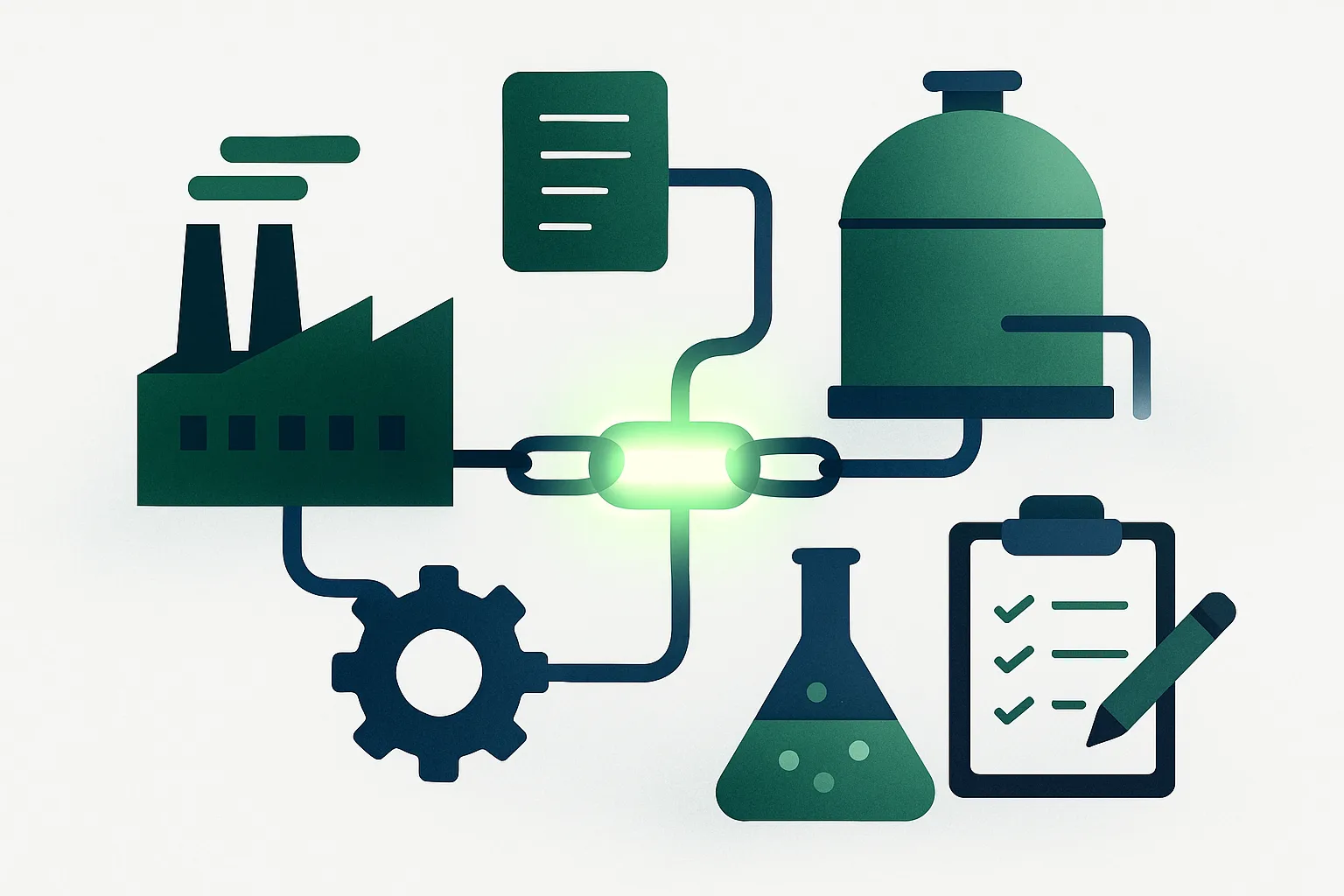
Performance plays out along a chain of four links. As soon as one link depends on a single person, the whole chain becomes fragile.
What should really happen on the floor — rarely written down as it is actually executed.
The most fragile link: 80% of critical knowledge stays informal and non-transmissible here.
Every operator should execute the same way, at the right level — across all sites.
Detect, handle and learn from deviations to turn risk into a shared asset.
From risk to response
Every form of key-person dependency has a concrete answer: capture the knowledge before it leaves.
| Dependency situation | Consequence | Sinfony response |
|---|---|---|
| Departure or absence of an expert | Lost knowledge, lower performance. | Capture the critical know-how before the departure. |
| Long & costly onboarding | Slow ramp-up, errors. | Documentation and training: −50% onboarding effort. |
| Critical gesture "in the hands" | Variability and poor quality between operators. | AI video and micro-learning to transmit the gesture. |
| Bulky SOPs not followed | Gap between documentation and practice. | Simplification: −50% SOPs, −90% doc/training gap. |
| Knowledge not audit-ready | Inspection risk, fragile traceability. | Auditable certificates and audit-ready traceability. |
Why act now
2.7 years
median tenure with the same employer for 25–34-year-olds — versus 9.6 years for 55–64-year-olds. The generations that hold the knowledge are leaving as newer ones churn faster.
39%
of skills will be transformed or obsolete by 2030 — transmission can no longer rest on the presence of experts alone.
Our results
What our clients see once their know-how is captured and transmissible.
"I've worked here for six years, and no one had ever explained my job to me like that."
Where to start
Making performance independent of people starts with documenting, training and capturing.
Make the informal critical knowledge of today transmissible: −50% SOPs, −90% doc/training gap.
Learn more → MethodAssess → Transform → Sustain: a model designed to make your teams autonomous, without us.
Explore the method → Training200+ ready-to-deploy micro-learning modules to transmit your roles' critical knowledge fast.
Explore the catalog →Frequently asked questions
A 3–6-day assessment identifies your most exposed know-how and 80% of your levers. From €5k.